Big Dipper
The Big Dipper (also called the Plough) is an asterism, a star pattern that is not one of the 88 official constellations, made of seven stars in Ursa Major. Its brightest star is Alioth (magnitude 1.77), and it is best seen in the evening in May.
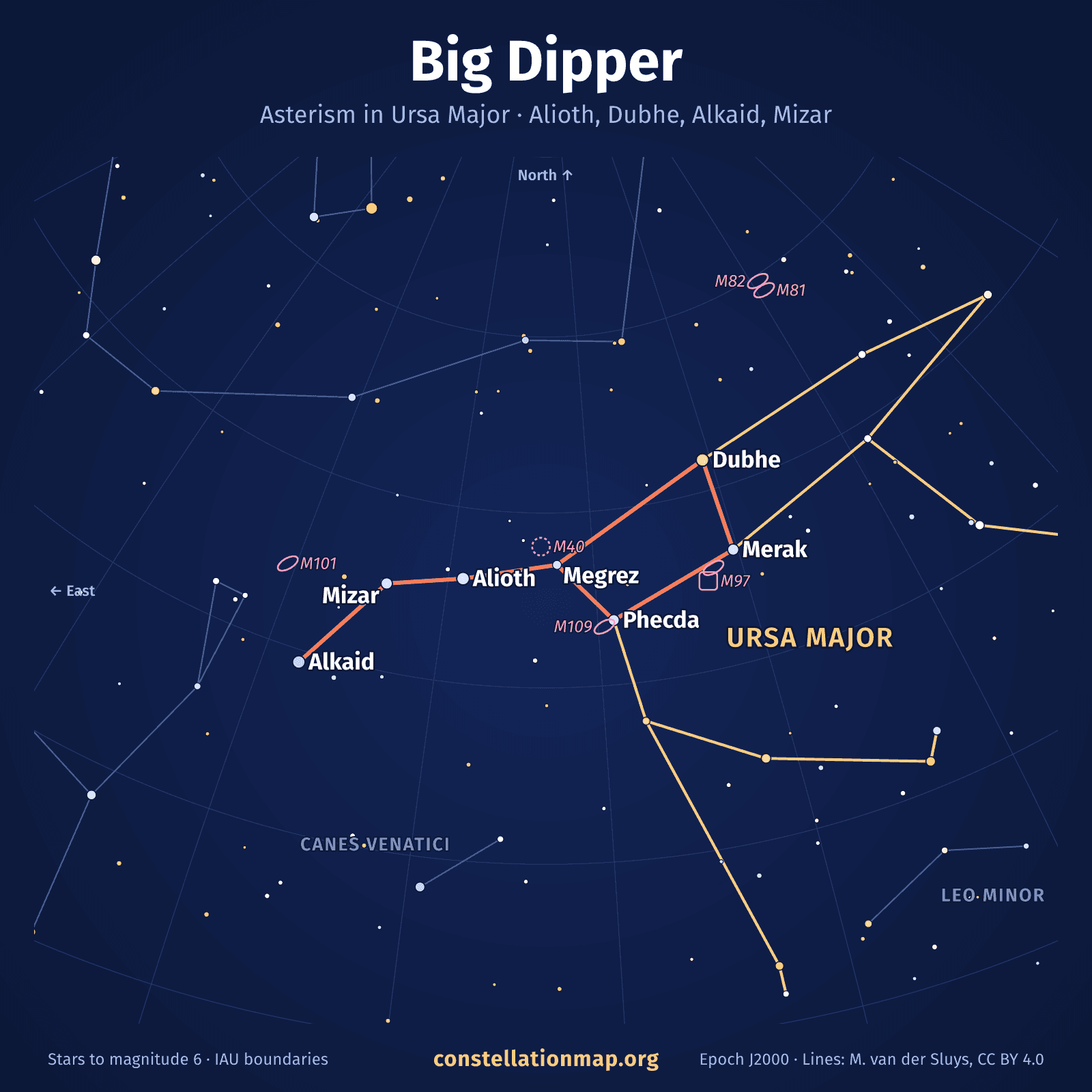
Free to use with credit: Atlas of the Sky (constellationmap.org), CC BY 4.0 · More
Embed this image on your website
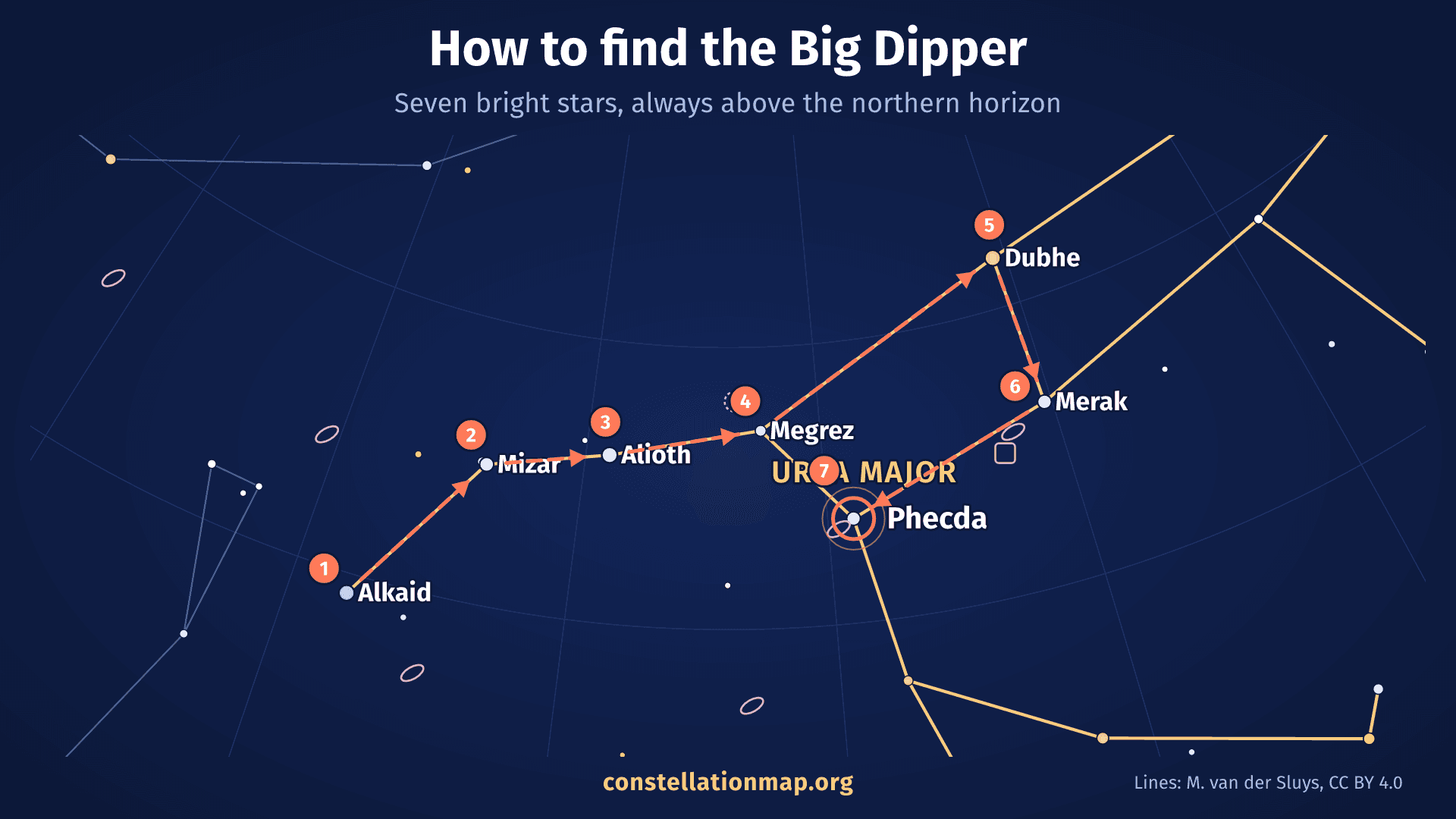
How to find the Big Dipper, step by step
Seven bright stars, always above the northern horizon.
- Face north. From mid-northern latitudes the Big Dipper never sets: it is high in spring, low in autumn.
- Look for seven stars of similar brightness forming a pan (the bowl) with a long bent handle.
- Mizar, in the middle of the handle, has a faint companion, Alcor, that you can see with good eyes.
Big Dipper or Ursa Major?
The Big Dipper (the Plough in the UK and Ireland) is not one of the 88 constellations. Its seven stars are part of Ursa Major, the Great Bear: the bowl is the bear's back and the handle its tail.
How to use it
Follow the two stars at the front of the bowl, Merak and Dubhe, about five times their distance to reach Polaris, the North Star; follow the arc of the handle to Arcturus.
How to find the Big Dipper
From 40° N (the USA, southern Europe, Japan) it never sets and is visible every clear night, highest in the north about 74° up. From 35° S (Australia, South Africa, Argentina) it stays below the horizon.
Stars of the Big Dipper
| Star | Designation | Magnitude | Distance | Constellation |
|---|---|---|---|---|
| Alioth | ε Ursae Majoris | 1.77 | 79 ly | Ursa Major |
| Dubhe | α Ursae Majoris | 1.79 | 123 ly | Ursa Major |
| Alkaid | η Ursae Majoris | 1.86 | 100 ly | Ursa Major |
| Mizar | ζ Ursae Majoris | 2.27 | 83 ly | Ursa Major |
| Merak | β Ursae Majoris | 2.37 | 97 ly | Ursa Major |
| Phecda | γ Ursae Majoris | 2.44 | 111 ly | Ursa Major |
| Megrez | δ Ursae Majoris | 3.31 | 81 ly | Ursa Major |
Questions about the Big Dipper
Is the Big Dipper a constellation?
No. The Big Dipper is an asterism: its stars belong to the constellation Ursa Major, one of the 88 constellations defined by the International Astronomical Union.
What is the brightest star of the Big Dipper?
Alioth, with an apparent magnitude of 1.77, about 79 light-years away.
When can I see the Big Dipper?
It is highest in the evening sky in May. From mid-northern latitudes it never sets.
Other asterisms
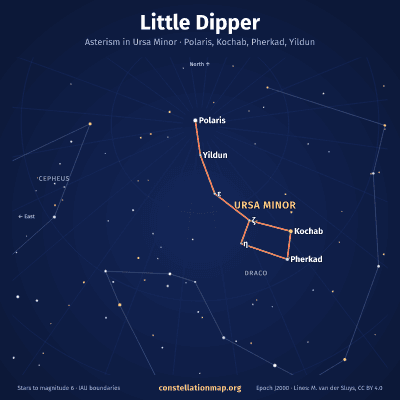 Little DipperUrsa Minor
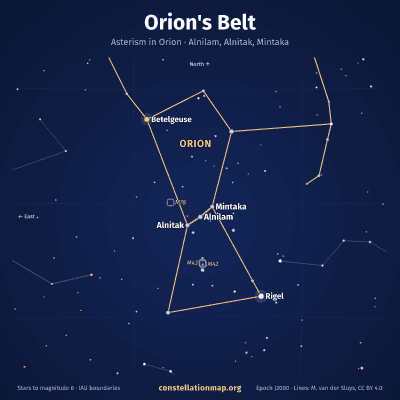 Orion's BeltOrion
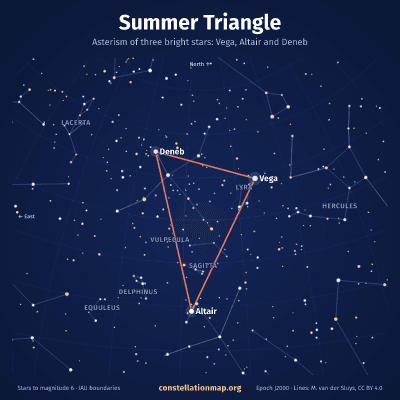 Summer TriangleLyra, Aquila and Cygnus
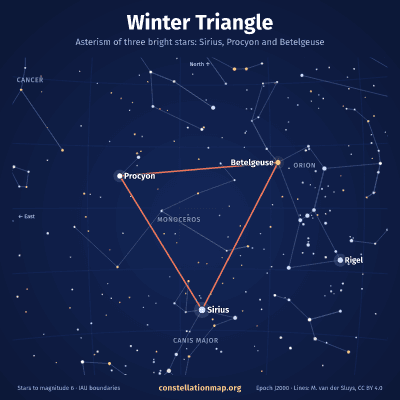 Winter TriangleCanis Major, Canis Minor and Orion
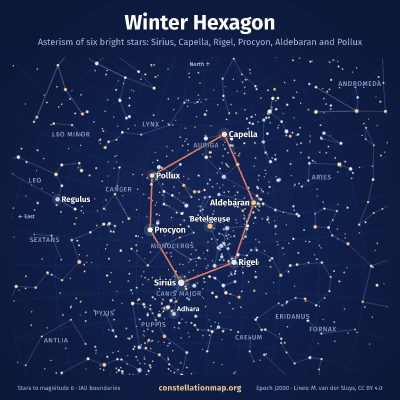 Winter HexagonCanis Major, Auriga, Orion, Canis Minor, Taurus and Gemini
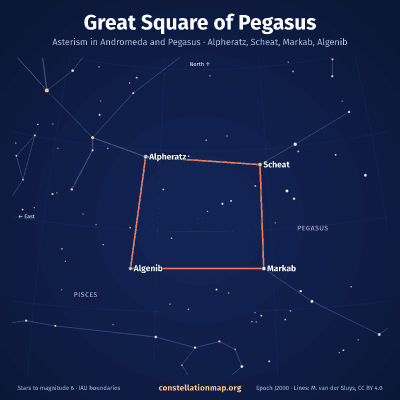 Great Square of PegasusAndromeda and Pegasus
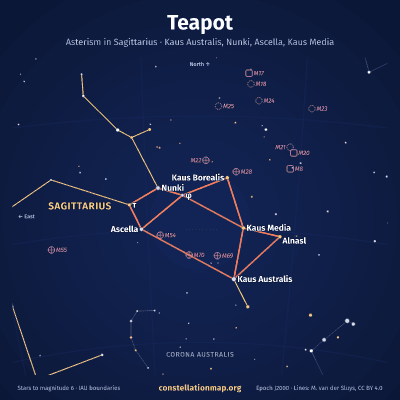 TeapotSagittarius
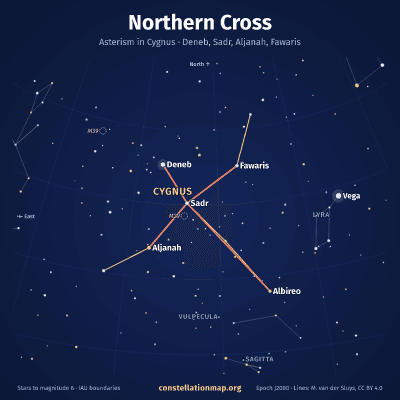 Northern CrossCygnus
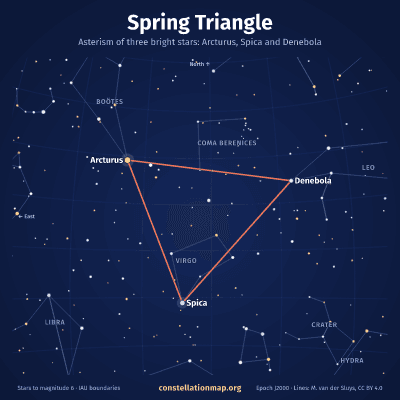 Spring TriangleBoötes, Virgo and Leo
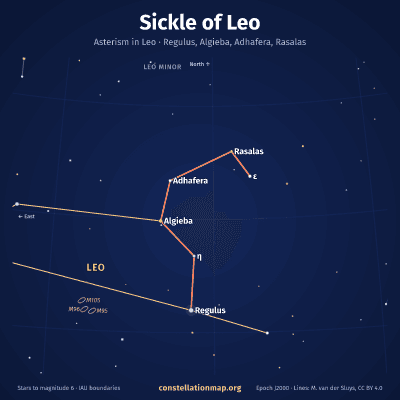 Sickle of LeoLeo
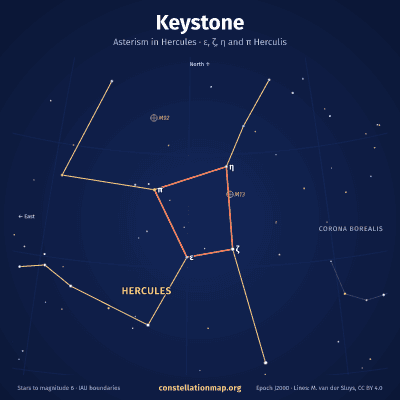 KeystoneHercules
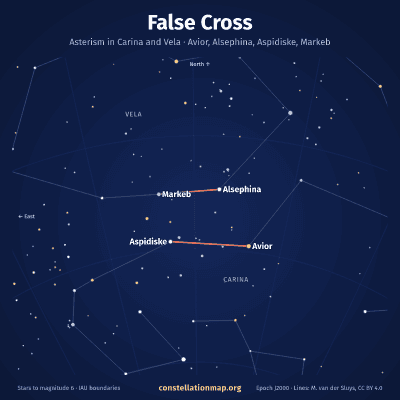 False CrossCarina and Vela
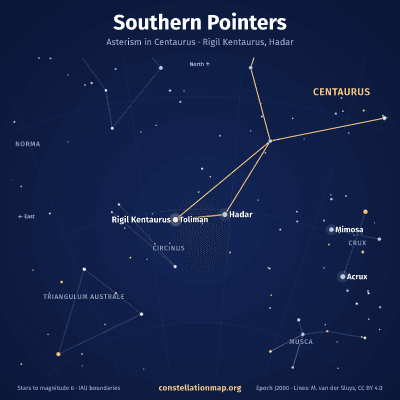 Southern PointersCentaurus