Polaris
Polaris (α Ursae Minoris) is a yellow-white supergiant star in the constellation Ursa Minor. With an apparent magnitude of 2.02 it is the 51st-brightest star in the night sky, and it is about 432 light-years from Earth.
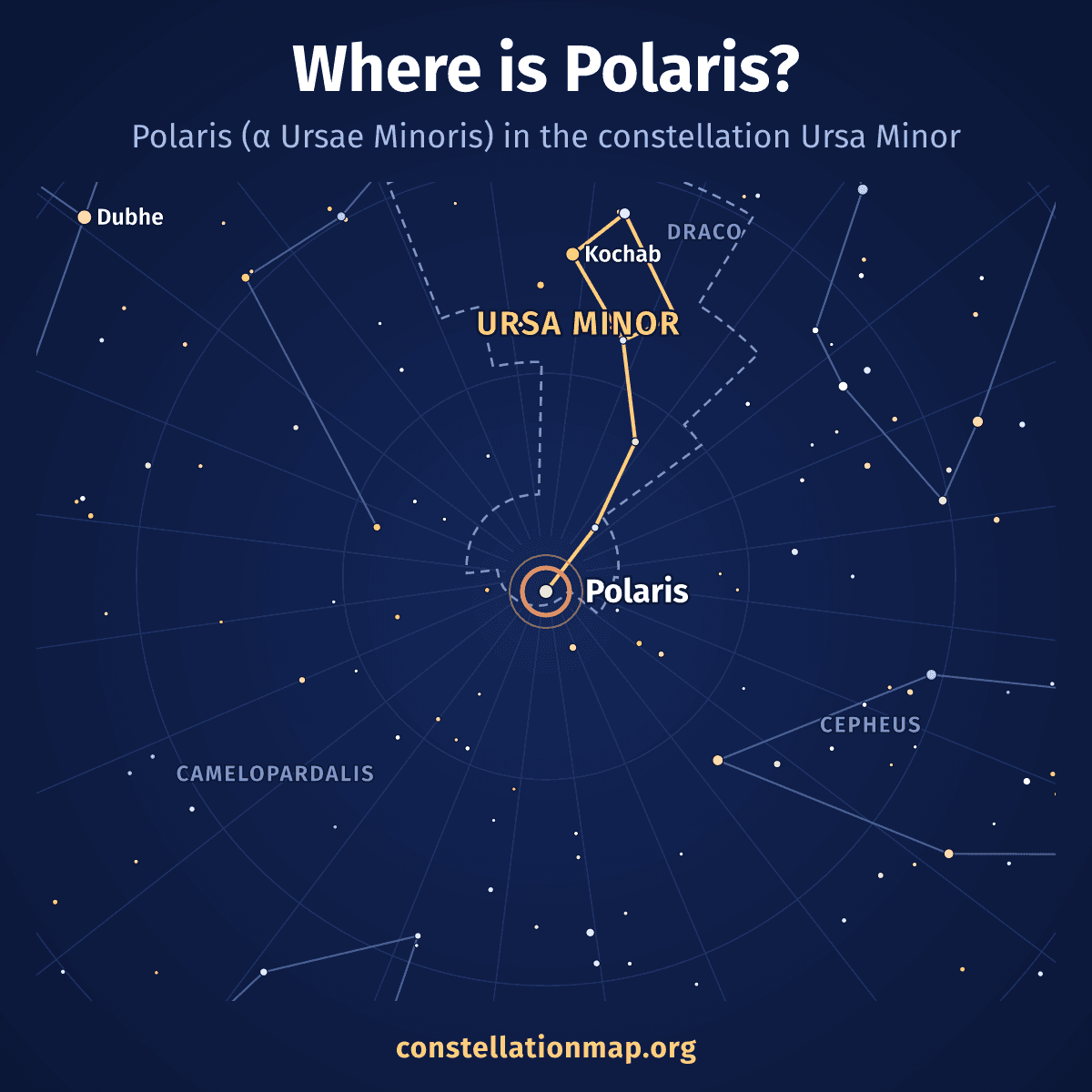
Free to use with credit: Atlas of the Sky (constellationmap.org), CC BY 4.0 · More
Embed this image on your website
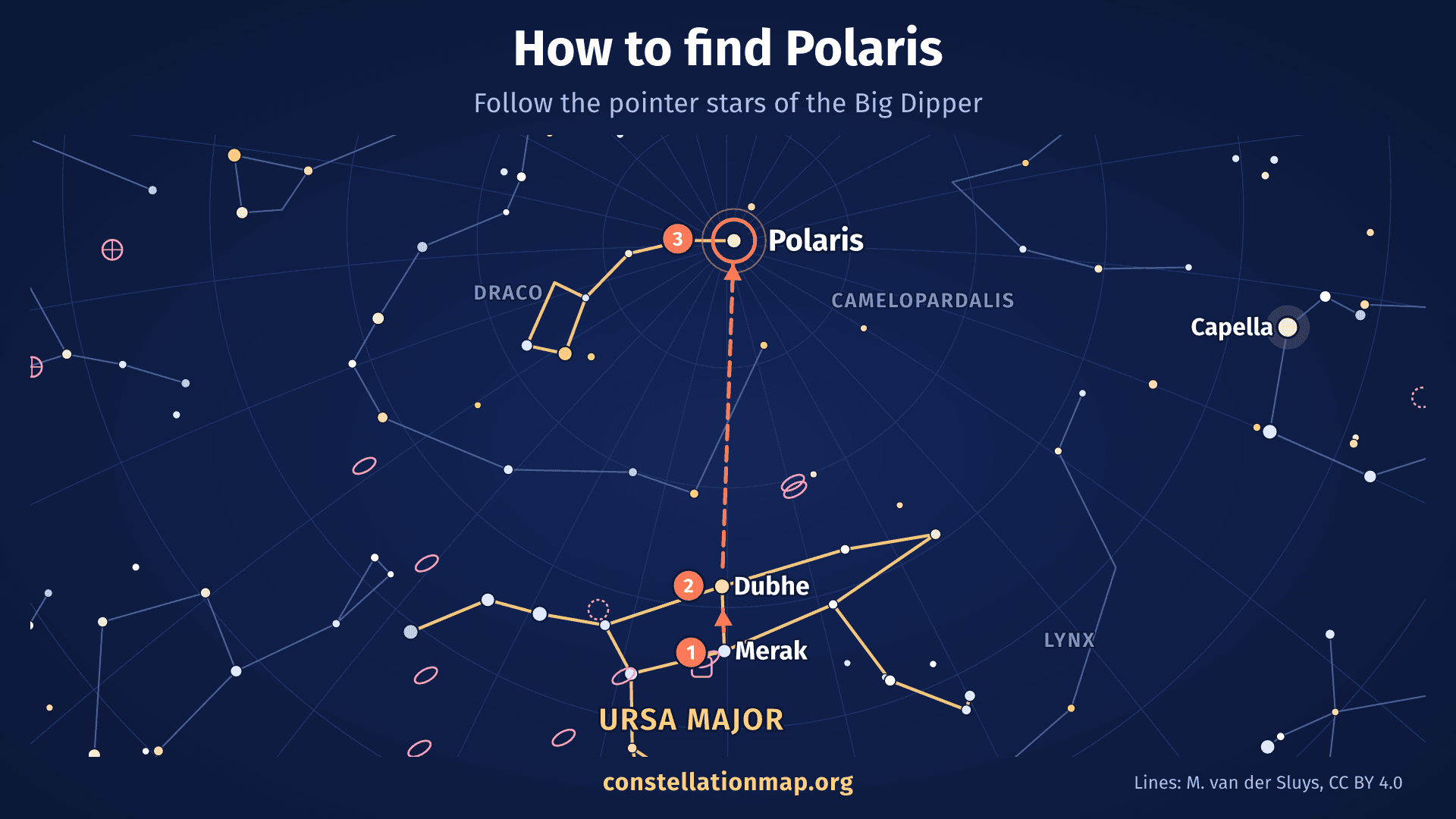
How to find Polaris, step by step
Follow the pointer stars of the Big Dipper.
- Face north and find the Big Dipper.
- Take the two stars at the front of the bowl, Merak and Dubhe: the Pointers.
- Follow the line from Merak through Dubhe about five times their distance. The moderately bright star there is Polaris; its height above the horizon equals your latitude.
Is Polaris the brightest star?
No. Polaris is only about the 48th-brightest star in the night sky. It is famous because it lies less than one degree from the north celestial pole, so it barely moves while the rest of the sky turns around it.
Facts
| Constellation | Ursa Minor |
|---|---|
| Designation | α Ursae Minoris (Alpha Ursae Minoris), HR 424 |
| Apparent magnitude | 2.02 (51st brightest) |
| Spectral type | F7:Ib-II |
| Color | yellow-white (B−V 0.60) |
| Distance | about 432 light-years |
| Right ascension | 2 h 31.8 min |
| Declination | +89.26° |
| Best month | December (at about 9 pm) |
How to find Polaris
Polaris is in Ursa Minor. From 40° N it never sets; it is highest in the north, about 41° up. From 35° S it stays below the horizon. Nearby bright stars: Kochab (17° away), Alderamin (27° away) and Dubhe (29° away).