Vindemiatrix
Vindemiatrix (ε Virginis) is a yellow supergiant star in the constellation Virgo. With an apparent magnitude of 2.83 it is the 137th-brightest star in the night sky, and it is about 108 light-years from Earth.
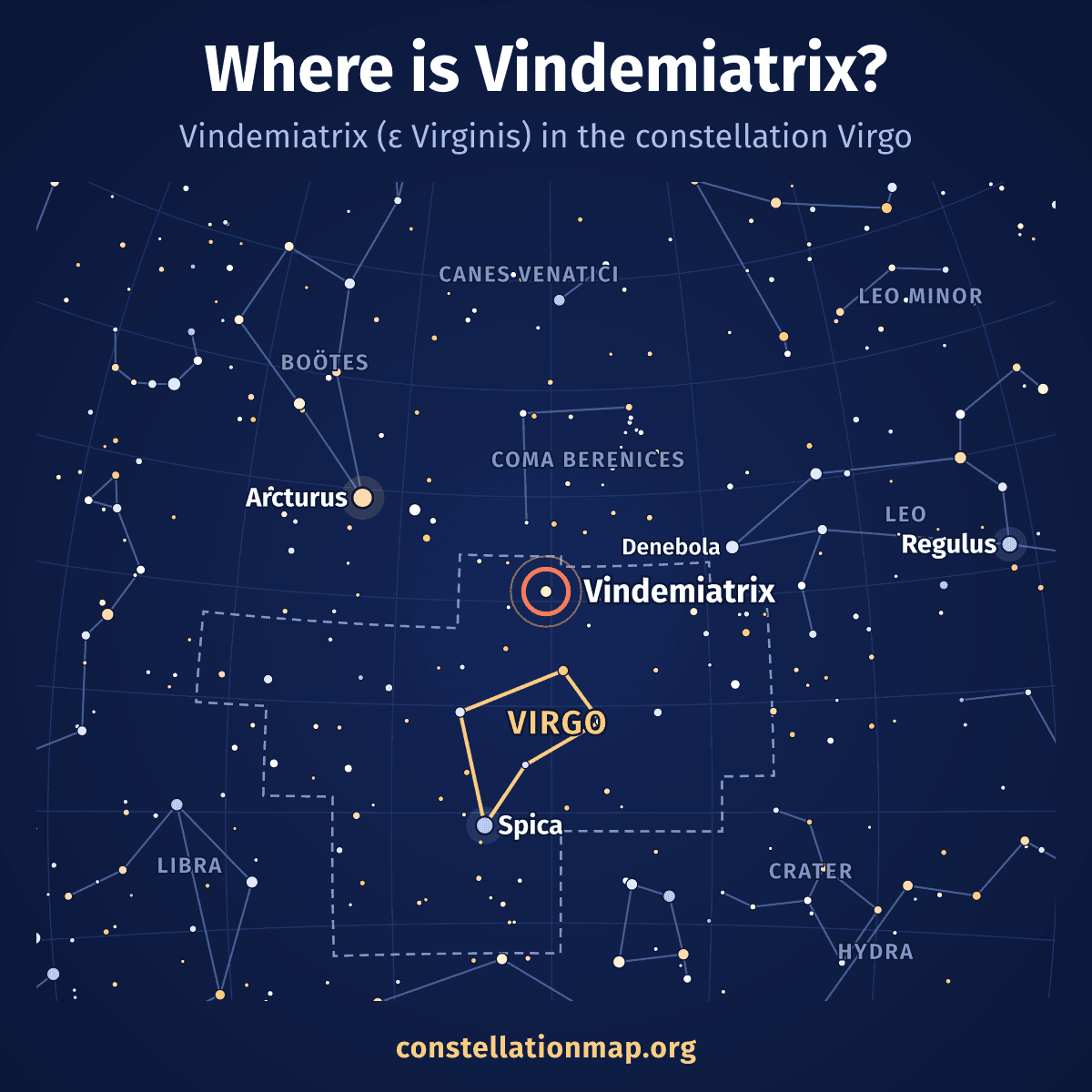
Free to use with credit: Atlas of the Sky (constellationmap.org), CC BY 4.0 · More
Embed this image on your website
Facts
| Constellation | Virgo |
|---|---|
| Designation | ε Virginis (Epsilon Virginis), HR 4932 |
| Apparent magnitude | 2.83 (137th brightest) |
| Spectral type | G8IIIab |
| Color | yellow (B−V 0.94) |
| Distance | about 108 light-years |
| Right ascension | 13 h 2.2 min |
| Declination | +10.96° |
| Best month | May (at about 9 pm) |
How to find Vindemiatrix
Vindemiatrix is in Virgo. From 40° N it is highest in the south in May evenings, about 61° above the horizon. From 35° S it reaches about 44° in the north. Nearby bright stars: Denebola (18° away), Arcturus (20° away) and Spica (23° away).
Where on Earth can you see Vindemiatrix?
Vindemiatrix is best seen in the evening in May. The table shows, for different latitudes, whether it ever rises and how high it climbs when it crosses the meridian.
| Latitude | Visibility | Highest point |
|---|---|---|
| 60° N (Oslo, Helsinki) | Rises and sets | 41° (south) |
| 50° N (Frankfurt, Prague) | Rises and sets | 51° (south) |
| 40° N (New York, Madrid, Beijing) | Rises and sets | 61° (south) |
| 30° N (Cairo, New Orleans) | Rises and sets | 71° (south) |
| 20° N (Mexico City, Mumbai) | Rises and sets | 81° (south) |
| 0° (Quito, Nairobi) | Rises and sets | 79° (north) |
| 20° S (Rio de Janeiro area) | Rises and sets | 59° (north) |
| 35° S (Sydney, Buenos Aires) | Rises and sets | 44° (north) |
| 45° S (Dunedin, southern Patagonia) | Rises and sets | 34° (north) |
How far away is Vindemiatrix?
Vindemiatrix is about 108 light-years from Earth. The light you see tonight left the star around the year 1920. That is about 25 times farther than Alpha Centauri, the nearest star system to the Sun.
What kind of star is Vindemiatrix?
Vindemiatrix has the spectral type G8IIIab. Stars of class G have surface temperatures of about 5,200 to 6,000 kelvin, which makes them look yellow. It is a supergiant: a massive star late in its life, far larger and many thousands of times more luminous than the Sun.
Messier objects near Vindemiatrix
Within 12° of Vindemiatrix (about the width of a fist at arm's length) lie Messier 60 (M60) at 5°, Messier 59 (M59) at 5°, Messier 58 (M58) at 6°, Messier 90 (M90) at 7°, Messier 89 (M89) at 7° and Messier 91 (M91) at 7°.
Questions about Vindemiatrix
How far away is Vindemiatrix?
About 108 light-years. The light we see today left it around the year 1920.
What color is Vindemiatrix?
Vindemiatrix looks yellow. Its spectral type is G8IIIab, which means a surface temperature of about 5,200 to 6,000 kelvin.
Can you see Vindemiatrix from the Northern Hemisphere?
Yes. From 40° N it rises and sets; at its highest it stands 61° high in the south.
Can you see Vindemiatrix from the Southern Hemisphere?
Yes. From 35° S it rises and sets; at its highest it stands 44° high in the north.
When is the best time to see Vindemiatrix?
In the evening in May, when it is highest at about 9 pm. It is 2.83 magnitude, the 137th-brightest star in the night sky.