Muliphein
Muliphein (γ Canis Majoris) is a blue-white bright giant star in the constellation Canis Major. With an apparent magnitude of 4.12 it is the 589th-brightest star in the night sky, and it is about 313 light-years from Earth.
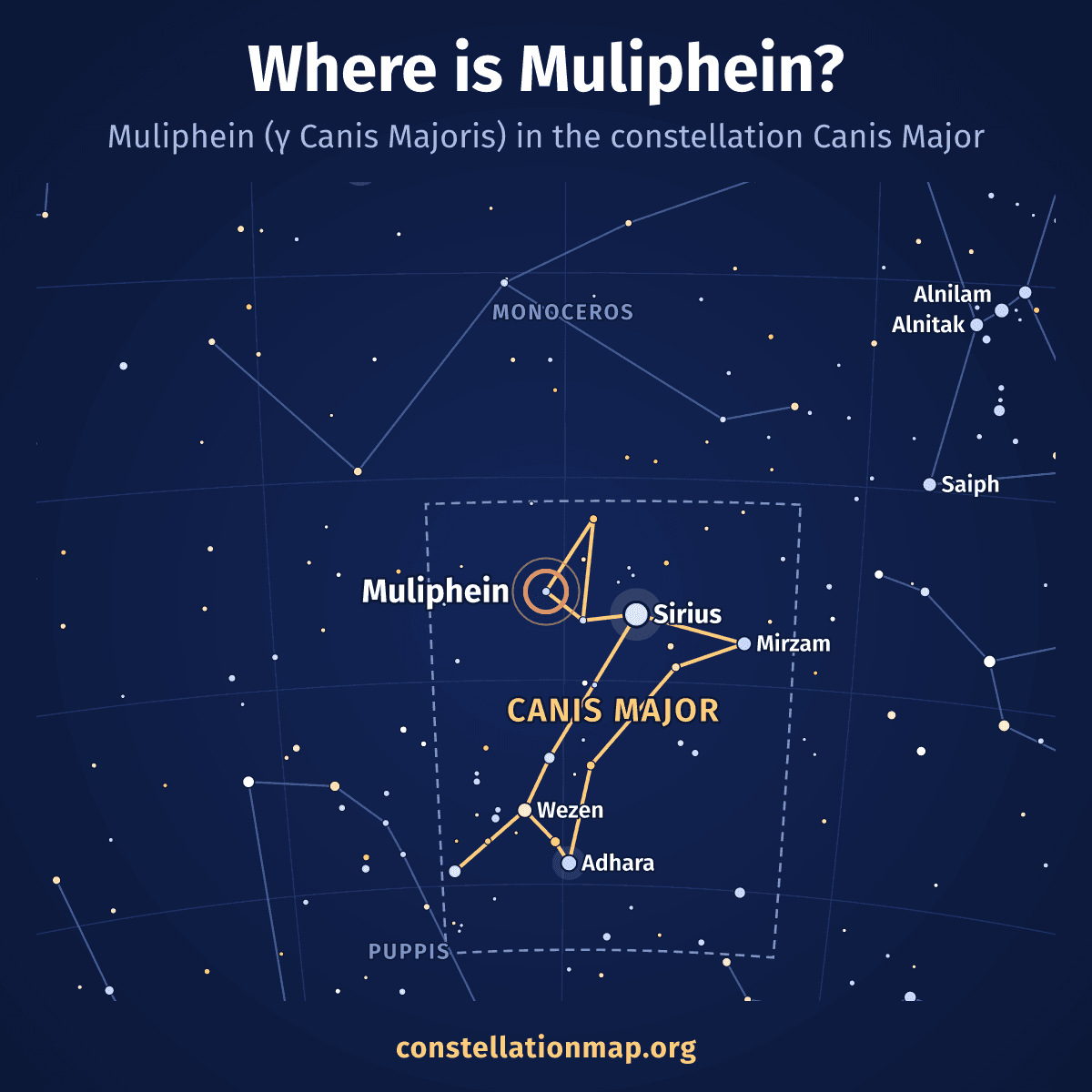
Free to use with credit: Atlas of the Sky (constellationmap.org), CC BY 4.0 · More
Embed this image on your website
Facts
| Constellation | Canis Major |
|---|---|
| Designation | γ Canis Majoris (Gamma Canis Majoris), HR 2657 |
| Apparent magnitude | 4.12 (589th brightest) |
| Spectral type | B8II |
| Color | blue-white (B−V -0.12) |
| Distance | about 313 light-years |
| Right ascension | 7 h 3.8 min |
| Declination | −15.63° |
| Best month | February (at about 9 pm) |
How to find Muliphein
Muliphein is in Canis Major. From 40° N it is highest in the south in February evenings, about 34° above the horizon. From 35° S it reaches about 71° in the north. Nearby bright stars: Sirius (5° away), Mirzam (10° away) and Wezen (11° away).
Where on Earth can you see Muliphein?
Muliphein is best seen in the evening in February. The table shows, for different latitudes, whether it ever rises and how high it climbs when it crosses the meridian.
| Latitude | Visibility | Highest point |
|---|---|---|
| 60° N (Oslo, Helsinki) | Rises and sets | 14° (south) |
| 50° N (Frankfurt, Prague) | Rises and sets | 24° (south) |
| 40° N (New York, Madrid, Beijing) | Rises and sets | 34° (south) |
| 30° N (Cairo, New Orleans) | Rises and sets | 44° (south) |
| 20° N (Mexico City, Mumbai) | Rises and sets | 54° (south) |
| 0° (Quito, Nairobi) | Rises and sets | 74° (south) |
| 20° S (Rio de Janeiro area) | Rises and sets | 86° (north) |
| 35° S (Sydney, Buenos Aires) | Rises and sets | 71° (north) |
| 45° S (Dunedin, southern Patagonia) | Rises and sets | 61° (north) |
How far away is Muliphein?
Muliphein is about 313 light-years from Earth. The light you see tonight left the star around the year 1710. That is about 72 times farther than Alpha Centauri, the nearest star system to the Sun.
What kind of star is Muliphein?
Muliphein has the spectral type B8II. Stars of class B have surface temperatures of about 10,000 to 30,000 kelvin, which makes them look blue-white. It is a bright giant: an evolved star, much larger and more luminous than the Sun.
Messier objects near Muliphein
Within 12° of Muliphein (about the width of a fist at arm's length) lie Messier 41 (M41) at 7°, Messier 50 (M50) at 7°, Messier 47 (M47) at 8° and Messier 46 (M46) at 9°.
Questions about Muliphein
How far away is Muliphein?
About 313 light-years. The light we see today left it around the year 1710.
What color is Muliphein?
Muliphein looks blue-white. Its spectral type is B8II, which means a surface temperature of about 10,000 to 30,000 kelvin.
Can you see Muliphein from the Northern Hemisphere?
Yes. From 40° N it rises and sets; at its highest it stands 34° high in the south.
Can you see Muliphein from the Southern Hemisphere?
Yes. From 35° S it rises and sets; at its highest it stands 71° high in the north.
When is the best time to see Muliphein?
In the evening in February, when it is highest at about 9 pm. It is 4.12 magnitude, the 589th-brightest star in the night sky.